00–59 lamp clock
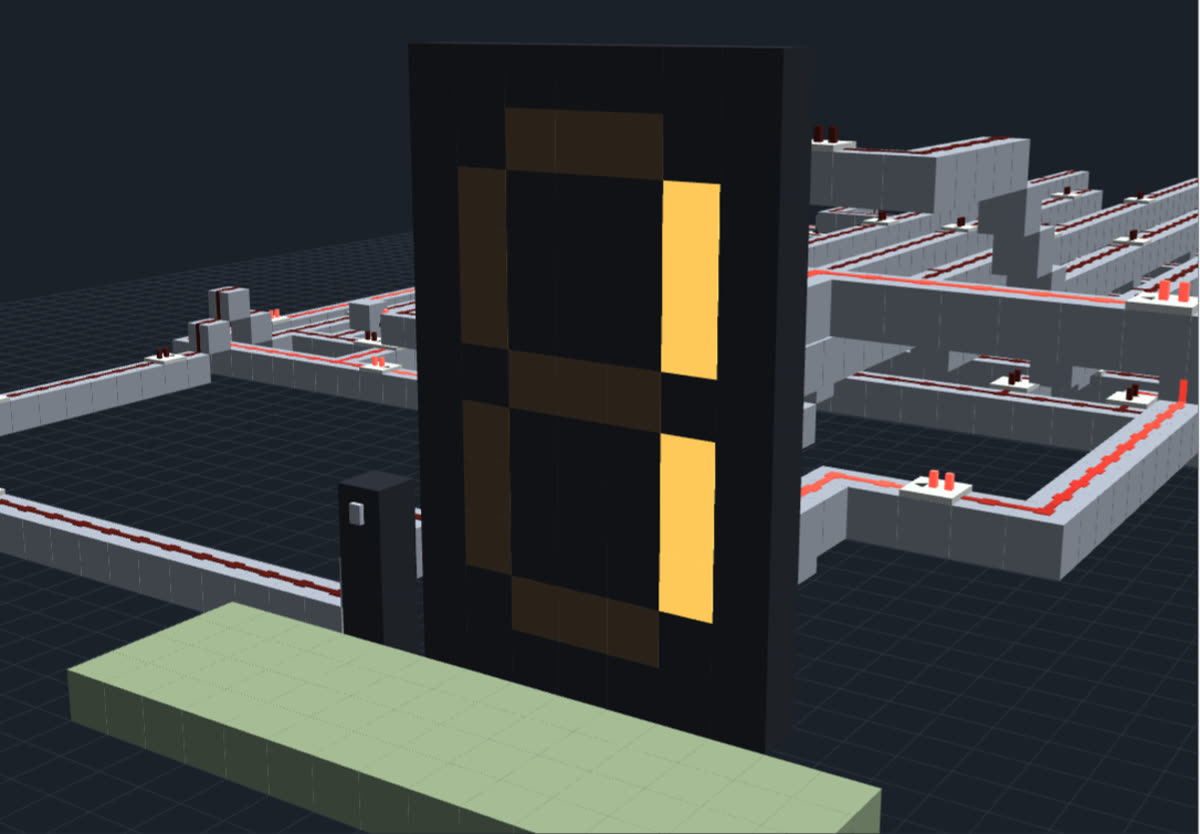
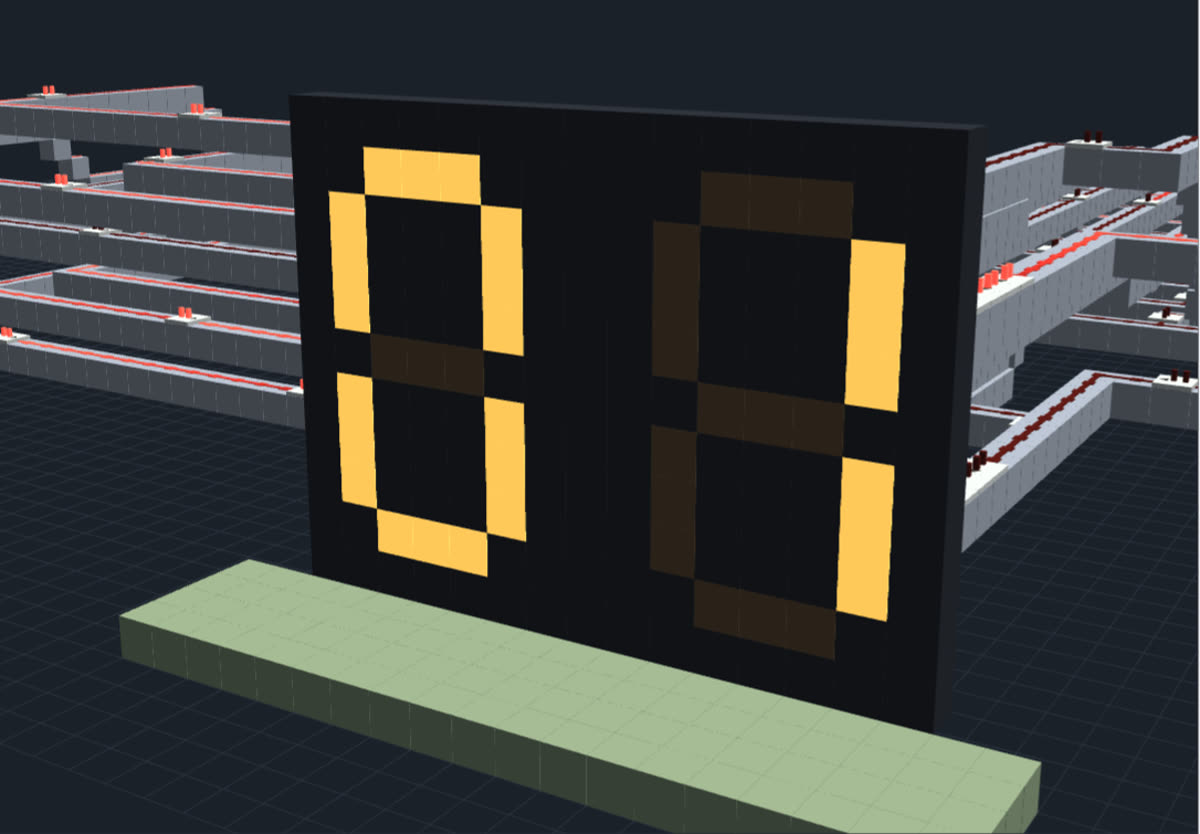
Pull the lever and the clock counts seconds from 00 to 59 and back to 00 on two big lamp digits. The ones digit is the 0–9 counter's modules, the tens digit is the same with three cells, and a carry links them.
How it works, part by part
1 · Ones counter cell 0A master-slave flip-flop used as a D flip-flop: on each clock pulse it stores whatever is on its input. Its input is the return wire, NOT Q4. The 5 cells form a Johnson counter: 10 states, one per digit 0 to 9.
2 · Ones counter cell 1A master-slave flip-flop used as a D flip-flop: on each clock pulse it stores whatever is on its input. Its input is cell 0's output. The 5 cells form a Johnson counter: 10 states, one per digit 0 to 9.
3 · Ones counter cell 2A master-slave flip-flop used as a D flip-flop: on each clock pulse it stores whatever is on its input. Its input is cell 1's output. The 5 cells form a Johnson counter: 10 states, one per digit 0 to 9.
4 · Ones counter cell 3A master-slave flip-flop used as a D flip-flop: on each clock pulse it stores whatever is on its input. Its input is cell 2's output. The 5 cells form a Johnson counter: 10 states, one per digit 0 to 9.
5 · Ones counter cell 4A master-slave flip-flop used as a D flip-flop: on each clock pulse it stores whatever is on its input. Its input is cell 3's output. The 5 cells form a Johnson counter: 10 states, one per digit 0 to 9.
6 · Ones clock busCarries each clock pulse to all 5 cells at once, over a little bridge across the return wire.
7 · Ones return wireA torch on the last cell gives NOT Q4, and this wire carries it back to cell 0's input: feeding back the inverted last bit makes 5 cells count 10 steps.
8 · Ones edge detectorA comparator in subtract mode reads a signal at its back and a copy delayed by a repeater at its side, so each rising edge becomes one 4-tick clock pulse. Its input is the clock.
9 · Ones decoder for 0 and 5Two comparators in subtract mode, one per digit: each is on only while its left cell is on and its right cell is off, so exactly one digit wire is on at a time.
10 · Ones decoder for 1 and 6Two comparators in subtract mode, one per digit: each is on only while its left cell is on and its right cell is off, so exactly one digit wire is on at a time.
11 · Ones decoder for 2 and 7Two comparators in subtract mode, one per digit: each is on only while its left cell is on and its right cell is off, so exactly one digit wire is on at a time.
12 · Ones decoder for 3 and 8Two comparators in subtract mode, one per digit: each is on only while its left cell is on and its right cell is off, so exactly one digit wire is on at a time.
13 · Ones decoder for 4 and 9Two comparators in subtract mode, one per digit: each is on only while its left cell is on and its right cell is off, so exactly one digit wire is on at a time.
14 · Ones digit 0 wireOn only while the ones show 0. It joins the ROM rows of the segments that make a 0.
15 · Ones digit 1 wireOn only while the ones show 1. It joins the ROM rows of the segments that make a 1.
16 · Ones digit 2 wireOn only while the ones show 2. It joins the ROM rows of the segments that make a 2.
17 · Ones digit 3 wireOn only while the ones show 3. It joins the ROM rows of the segments that make a 3.
18 · Ones digit 4 wireOn only while the ones show 4. It joins the ROM rows of the segments that make a 4.
19 · Ones digit 5 wireOn only while the ones show 5. It joins the ROM rows of the segments that make a 5.
20 · Ones digit 6 wireOn only while the ones show 6. It joins the ROM rows of the segments that make a 6.
21 · Ones digit 7 wireOn only while the ones show 7. It joins the ROM rows of the segments that make a 7.
22 · Ones digit 8 wireOn only while the ones show 8. It joins the ROM rows of the segments that make a 8.
23 · Ones digit 9 wireOn only while the ones show 9. It joins the ROM rows of the segments that make a 9.
24 · Ones ROM row aSegment a (top) is lit for 0, 2, 3, 5, 6, 7, 8 and 9. Each of those digit wires joins this row through a one-way repeater.
25 · Ones segment a wireRuns from the ROM to segment a of the ones digit on the wall.
26 · Ones ROM row bSegment b (top right) is lit for 0, 1, 2, 3, 4, 7, 8 and 9. Each of those digit wires joins this row through a one-way repeater.
27 · Ones segment b wireRuns from the ROM to segment b of the ones digit on the wall.
28 · Ones ROM row cSegment c (bottom right) is lit for 0, 1, 3, 4, 5, 6, 7, 8 and 9. Each of those digit wires joins this row through a one-way repeater.
29 · Ones segment c wireRuns from the ROM to segment c of the ones digit on the wall.
30 · Ones ROM row dSegment d (bottom) is lit for 0, 2, 3, 5, 6, 8 and 9. Each of those digit wires joins this row through a one-way repeater.
31 · Ones segment d wireRuns from the ROM to segment d of the ones digit on the wall.
32 · Ones ROM row eSegment e (bottom left) is lit for 0, 2, 6 and 8. Each of those digit wires joins this row through a one-way repeater.
33 · Ones segment e wireRuns from the ROM to segment e of the ones digit on the wall.
34 · Ones ROM row fSegment f (top left) is lit for 0, 4, 5, 6, 8 and 9. Each of those digit wires joins this row through a one-way repeater.
35 · Ones segment f wireRuns from the ROM to segment f of the ones digit on the wall.
36 · Ones ROM row gSegment g (middle) is lit for 2, 3, 4, 5, 6, 8 and 9. Each of those digit wires joins this row through a one-way repeater.
37 · Ones segment g wireRuns from the ROM to segment g of the ones digit on the wall.
38 · Tens counter cell 0A master-slave flip-flop used as a D flip-flop: on each clock pulse it stores whatever is on its input. Its input is the return wire, NOT Q2. The 3 cells form a Johnson counter: 6 states, one per digit 0 to 5.
39 · Tens counter cell 1A master-slave flip-flop used as a D flip-flop: on each clock pulse it stores whatever is on its input. Its input is cell 0's output. The 3 cells form a Johnson counter: 6 states, one per digit 0 to 5.
40 · Tens counter cell 2A master-slave flip-flop used as a D flip-flop: on each clock pulse it stores whatever is on its input. Its input is cell 1's output. The 3 cells form a Johnson counter: 6 states, one per digit 0 to 5.
41 · Tens clock busCarries each clock pulse to all 3 cells at once, over a little bridge across the return wire.
42 · Tens return wireA torch on the last cell gives NOT Q2, and this wire carries it back to cell 0's input: feeding back the inverted last bit makes 3 cells count 6 steps.
43 · Tens edge detectorA comparator in subtract mode reads a signal at its back and a copy delayed by a repeater at its side, so each rising edge becomes one 4-tick clock pulse. Its input is the carry from the ones.
44 · Tens decoder for 0 and 3Two comparators in subtract mode, one per digit: each is on only while its left cell is on and its right cell is off, so exactly one digit wire is on at a time.
45 · Tens decoder for 1 and 4Two comparators in subtract mode, one per digit: each is on only while its left cell is on and its right cell is off, so exactly one digit wire is on at a time.
46 · Tens decoder for 2 and 5Two comparators in subtract mode, one per digit: each is on only while its left cell is on and its right cell is off, so exactly one digit wire is on at a time.
47 · Tens digit 0 wireOn only while the tens show 0. It joins the ROM rows of the segments that make a 0.
48 · Tens digit 1 wireOn only while the tens show 1. It joins the ROM rows of the segments that make a 1.
49 · Tens digit 2 wireOn only while the tens show 2. It joins the ROM rows of the segments that make a 2.
50 · Tens digit 3 wireOn only while the tens show 3. It joins the ROM rows of the segments that make a 3.
51 · Tens digit 4 wireOn only while the tens show 4. It joins the ROM rows of the segments that make a 4.
52 · Tens digit 5 wireOn only while the tens show 5. It joins the ROM rows of the segments that make a 5.
53 · Tens ROM row aSegment a (top) is lit for 0, 2, 3 and 5. Each of those digit wires joins this row through a one-way repeater.
54 · Tens segment a wireRuns from the ROM to segment a of the tens digit on the wall.
55 · Tens ROM row bSegment b (top right) is lit for 0, 1, 2, 3 and 4. Each of those digit wires joins this row through a one-way repeater.
56 · Tens segment b wireRuns from the ROM to segment b of the tens digit on the wall.
57 · Tens ROM row cSegment c (bottom right) is lit for 0, 1, 3, 4 and 5. Each of those digit wires joins this row through a one-way repeater.
58 · Tens segment c wireRuns from the ROM to segment c of the tens digit on the wall.
59 · Tens ROM row dSegment d (bottom) is lit for 0, 2, 3 and 5. Each of those digit wires joins this row through a one-way repeater.
60 · Tens segment d wireRuns from the ROM to segment d of the tens digit on the wall.
61 · Tens ROM row eSegment e (bottom left) is lit for 0 and 2. Each of those digit wires joins this row through a one-way repeater.
62 · Tens segment e wireRuns from the ROM to segment e of the tens digit on the wall.
63 · Tens ROM row fSegment f (top left) is lit for 0, 4 and 5. Each of those digit wires joins this row through a one-way repeater.
64 · Tens segment f wireRuns from the ROM to segment f of the tens digit on the wall.
65 · Tens ROM row gSegment g (middle) is lit for 2, 3, 4 and 5. Each of those digit wires joins this row through a one-way repeater.
66 · Tens segment g wireRuns from the ROM to segment g of the tens digit on the wall.
67 · CarryQ4, the ones' last cell, turns off only when the ones go from 9 to 0. A comparator in subtract mode takes Q4 from a copy delayed 8 ticks, so it gives one pulse on that falling edge, and this long wire takes it to the tens' edge detector: the tens count once every ten seconds.
68 · Ones digitA 5 × 9 lamp digit. Each segment is three lamps; the repeater behind the middle lamp powers it, and lamps conduct, so it lights the other two.
69 · Tens digitThe tens digit, built like the ones: 0 to 5.
70 · Clock and leverA redstone torch clock: the torch turns its own block on through a 4-tick repeater, so it flips every 10 ticks, one pulse a second. While the lever is off, an inverter torch holds the clock still, and a comparator keeps the torch's flash as the machine loads from counting as a second.
71 · FloorSomewhere to stand in front of the display.
Build it
Materials
- 2,623× stone
- 2,047× redstone dust
- 339× repeater
- 42× redstone lamp
- 20× comparator
- 12× redstone torch
- 1× lever
A build guide and schematic downloads are coming. For now, turn the 3D view and click any block to see what it is.
Want a variant? Ask your AI.
Show me the 00–59 lamp clock from Contraptify and make a variant of it. How to connect your AI